
The Impossible Standard: The Double Bind
This piece is about the double bind. The specific trap that emerges when the evaluation framework for female founders was built around someone else entirely.


She walked into the Series A room.
Two years of building. Product in market. A team that was working. The metrics early investors said to hit… she’d hit them.
And something shifted.
The feedback wasn’t “lacks killer instinct” this time. It was softer. Harder to argue with. Something about the presentation style. Not quite the energy we’d expect at this stage. Hard to put a finger on.
Hard to put a finger on. After two years.
What changed wasn’t her capability. What changed was how her capability was being read. Through a framework that was never built with her in mind.
Getting to this room mattered. Most women don’t. The data from my last piece on the drop-off problem showed the pattern clearly: angel round → pre-seed → seed, the cheques get bigger, and women disappear from the numbers. She got through that filter. She made it to the room where the real capital lives.
And the room didn’t care.
The behaviour penalty and the double bind are not the same thing
In my last piece on the behaviour penalty, I covered the documented finding that feminine-coded behaviours: empathy, collaboration, transparent risk acknowledgment, get penalised regardless of who displays them. That’s one layer of the problem.
The double bind is adjacent, and in some ways harder to name.
It describes the specific trap that emerges when a person’s identity conflicts with the role they’re occupying. Eagly and Karau’s role congruity theory maps this precisely: women are expected to be warm, communal, accommodating. Leaders are expected to be assertive, dominant, decisive. These expectations don’t just differ. They actively contradict each other.
When a woman leads, she is evaluated against both sets simultaneously. She cannot satisfy both. And whichever one she prioritises, the other will be used against her.
Here is the distinction that matters. The behaviour penalty is about what you do. The double bind is about who you are perceived to be before you’ve opened your mouth.
Display warmth. Not CEO material.
Display assertiveness. Too abrasive.
Be ambitious. Unrealistic.
Be measured. Doesn’t think big enough.
Be collaborative. No killer instinct.
Be competitive. Wouldn’t be a good culture fit.


There is no version of this that wins. That is not an exaggeration. The game is not difficult. The game was designed with one exit, and it was never marked with her name.
What the research actually shows
Malin Malmström and colleagues at Luleå University of Technology recorded venture capital decision-making meetings and analysed the language investors used to evaluate founders across two years.[ltu]
The 2017 study documented four recurring patterns in how investors described female entrepreneurs: cautious and risk-averse. Reluctant to grow. Lacking resources for high growth. Likely to underperform. Male founders were described in near-opposite terms: ambitious, risk-taking, growth-oriented, high potential. The same evaluation, different lens.[semanticscholar]
The 2018 follow-up checked those characterisations against actual company performance data. No statistically significant differences between female and male ventures. None. The assumptions investors were articulating in the room had no basis in what the companies were actually doing.[ideas.repec]
The language wasn’t reflecting reality. It was constructing it. Investors talked women into a smaller box, then used the box as evidence she couldn’t fit a bigger one.
This is the double bind made operational. The filter is already in place before she walks in. She doesn’t need to display the wrong behaviour. The evaluation framework is already gendered.
How it compounds as capital scales
The 2025 Cut Through Venture State of Australian Startup Funding report tells a story of two halves.
The promising headline: female founders captured 24% of equity capital raised in Australia in 2025, up from 15% the prior year. Progress, on that number [australianstartupfunding].
When you delve further into the detail, we see: the share of total deals involving a female founder fell, from 27% to 23%. Female-only founding teams received 2% of capital, down from 4% the year prior. At Series B and beyond in 2025, every single round went to male-only teams. One hundred percent [linkedin].
The double bind helps explain why the numbers diverge at later stages. Early rounds are often relational. As rounds get larger, evaluation frameworks harden. The entrepreneurial prototype (discussed here) aggressive, visionary, individually dominant - becomes the gravitational centre.
The Mirror in the Glass: From Pitch Room to Boardroom
This isn’t just a venture capital problem. If you step out of the pitch room and into the ASX 300 boardroom, you’ll find the same mirror.
That 24% headline for “mixed-gender” teams in 2025 is largely a statistical illusion. It was almost entirely driven by a single $232M mega-round for Airwallex. Take that one outlier away, and the “progress” evaporates. Even in that success story, the CEO is male. The “mixed-gender” label often masks a reality where women are present in the founding team but rarely hold the keys to the top job as the company scales.
It is a perfect reflection of the Australian corporate landscape. In the ASX 300, 9 out of 10 CEOs are men. Even more telling, 41% of those companies have zero women in their CEO pipeline roles.
We are seeing the same graduation failure play out in parallel:
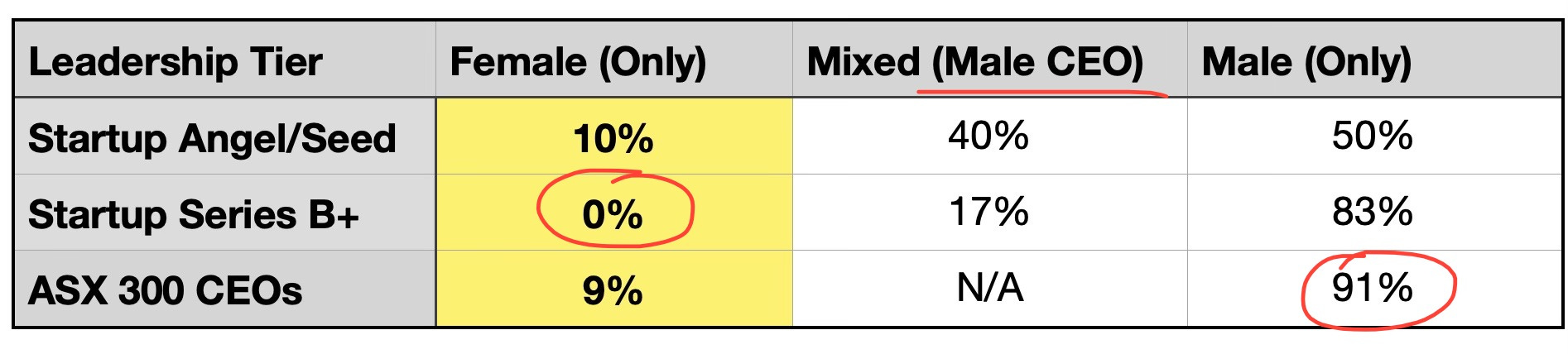
The data confirms what many of us feel: we aren’t seeing a pipeline problem. We are seeing an architectural one. By the time a company reaches Series B or a corporate division hits a billion-dollar budget, the system defaults to the only prototype it has ever truly trusted with that much capital: the one that looks like the people already in the room.
The bind travels. The room doesn’t matter.
I’ve sat with this question myself. If you remove the room (or the stage) and move to video submissions, strip back the physical presence, just evaluate the pitch on its own terms, does anything change?
It’s an appealing idea. I understand why I keep returning to it. The room carries so much. The handshake, the eye contact, the way a woman’s authority reads differently in a physical space designed around a different kind of authority. Remove all of that, and maybe the evaluation gets cleaner.
A 2025 study in the Journal of Finance gave me my answer. I’m not going to lie… I didn’t love it. Analysing thousands of investor pitch evaluations in video format, the researchers found that the penalty for being less passionate and positive in delivery was nine times larger for women than for men. Same format. Different experience.
Because the double bind is cognitive, not spatial. It isn’t produced by a room. It is produced by an evaluation framework that hasn’t been examined, one that carries gendered expectations about confidence, energy, and narrative authority into every context it touches, before the video plays, before she opens her mouth.
Megan Dalla-Camina, one of Australia’s most prominent researchers on women in leadership, calls this the Leadership Paradox. Organisations actively champion more women in leadership roles, then penalise them for every leadership style they adopt once they arrive. Too soft. Too hard. Never quite right. She spent two decades navigating this inside IBM and GE before she named it publicly.
The founder who walks into a Series A pitch having spent her career in corporate and tech environments isn’t encountering the double bind for the first time. She’s carrying it with her from every performance review, every promotion committee, every meeting where she recalibrated herself before speaking. The pitch room doesn’t introduce the bind. It concentrates it.
Research on women directors in corporate boardrooms found they developed six distinct participation tactics to navigate the double bind in real time — some warmth-based, some competence-based, hybrid approaches that shifted depending on who was in the room. And the researchers’ own conclusion was the part that stayed with me: “Women must never stop adapting to gendered expectations.” That constant adaptation - the ongoing management of how you’re being read, is a documented driver of burnout and attrition from leadership altogether. The OECD’s 2025 gender equality report named it as a primary explanation for why women continue to exit senior roles at higher rates than men, despite all the pipeline initiatives designed to get them there.
The pitch room concentrates it. But it isn’t where it starts. And removing the room doesn’t touch it, because the room was never the source.
The tax nobody accounts for
There is a cost to the double bind that appears in no funding report.
Male founders walk into a pitch room, or a stage or, open a video recording and pitch. That is the task.
Female founders pitch while simultaneously monitoring whether they’re presenting as warm enough without being too soft, assertive without triggering the “difficult” label, ambitious without tipping into unrealism, measured without signalling timidity. Two processes running in parallel. One is the pitch. The other is a continuous self-assessment exercise with no correct answer.
Research on stereotype threat shows that awareness of potential bias measurably impairs performance. When you know you are being evaluated through a filter that may work against you, part of your cognitive bandwidth goes into managing that knowledge. That bandwidth is not going into the pitch.[research.abo]
The gap in outcomes isn’t only about how investors perceive female founders. It is also about what it costs a founder to operate inside a system that makes her self-presentation a problem to be solved before she’s even addressed her market.
On intersectionality — briefly
The double bind I’ve described operates for women as a broad category. For women who are also from racially marginalised backgrounds, who are older (perimenopause, anyone?), neurodivergent, who are LGBTQ+, who are disabled, the binds don’t simply stack. They multiply. The distance between who she is and who the prototype assumes a founder to be widens with every dimension the system wasn’t designed to hold.
I am not going to do that justice in a paragraph. I will return to it properly. But I did not want to write about impossible standards without acknowledging that “impossible” is not a uniform experience. For some founders, the standard was constructed to exclude them specifically.
What investors can do — and what that won’t fix
A note before these: evaluating the founder is not just valid at early stage, it’s often the only thing you can evaluate. At pre-seed, there may be no model, no traction, no team beyond the person in front of you. You are backing a human being. That is correct. The question isn’t whether to assess the founder. The question is whether you’ve defined what “good founder” actually means and whether you’re applying that definition consistently, regardless of who’s sitting across from you.
Three things. A floor, not a ceiling.
Name what you mean before she walks in. You’re backing a person. That’s your job. But “energy,” “presence,” “hunger,” “gravitas,” and “polish” are descriptions, not criteria. Before the next pitch, write down what you’re actually looking for. Domain expertise. Speed of learning. Resilience under pressure. A genuine right-to-win in this market. These are assessable and applicable to everyone. But, as we have seen, the research on the double bind shows that these same underlying qualities read differently through a gendered lens. Resilience reads as stubbornness, domain expertise reads as niche, measured delivery reads as low ambition. Get specific about what you mean, and you’ll notice when your language starts to drift.
Apply the same scrutiny to every founder, not just the ones who don’t fit your pattern. Consider the questions you ask in your next ten first meetings. Are you asking everyone about risk and contingency? Or only some people? Are you asking everyone about growth and vision? Or only some people? You don’t have to abandon your instincts. But instincts formed across a career of funding a particular type of person carry that person’s shape. The audit isn’t about second-guessing yourself, it’s about checking whether you’re actually evaluating what you say you’re evaluating.
Distinguish between founder quality and pitch theatre. Early-stage investors are right that founder capability matters more than the deck. But founder capability and pitch performance are not the same thing, and the gap between them is widest for founders operating under stereotype threat. The research shows measurably impaired performance in high-stakes evaluation settings when a founder knows the evaluation framework may work against her. That impairment doesn’t appear in her track record, her problem insight, or her domain depth. If those signals are strong and the pitch felt “off,” ask what the pitch conditions produced before you file it as a character assessment. Look at the whole person. That’s your job. Just make sure you’re seeing the whole person and not a reflection of what you expected to see.
These three things matter. None of them dismantle the double bind, because the double bind isn’t produced by individual bad decisions. It’s held in place by evaluation frameworks that reward familiarity and penalise difference.
That’s what we look at next. How investors come to fund people who look like the people they’ve already funded. How that process disguises itself as “expertise”. And why the most durable forms of bias don’t require malice. They simply exist in a system that nobody has made accountable.
Sources
Eagly, A.H. & Karau, S.J. — Role Congruity Theory of Prejudice Toward Female Leaders, Psychological Review (2002)
Malmström, M., Johansson, J. & Wincent, J. — Gender Stereotypes and Venture Support Decisions, Entrepreneurship Theory and Practice (2017)
Malmström, M., Johansson, J. & Wincent, J. — When Stereotypical Gender Notions See the Light of Day, Will They Burst? Journal of Business Venturing Insights (2018)
Hu, A. & Ma, S. — Persuading Investors: A Video-Based Study, Journal of Finance (2025)
Hernandez, M., Trzebiatowski, T. & McCluney, C.L. — Managing the Double Bind, Organization Science (2022)
Steele, C.M. — A Threat in the Air, American Psychologist (1997)
Dalla-Camina, M. — Women Rising, Hay House (2024)
Cut Through Venture — State of Australian Startup Funding, Full-Year Report (2025)
OECD — Gender Equality in a Changing World (2025)
Disclaimer
My own words, my own research. Not financial advice. Just someone who's spent too long looking at this data and can no longer stay quiet about it.
I love how you pull forward the numbers and take the stats apart but have to admit: this leaves me a bit hopeless. Is there something I can do about it as a founder or honestly just person who is not an investor?
The part about emotional expression really lands because it's so invisible compared to the assertiveness trap. I've watched women get dinged for being "too passionate" about their work (unprofessional) and simultaneously for being "not invested enough" (not a culture fit). Same person, same meeting, different day. The structural bit is the key insight though - you can't individual-behaviour your way out of a contradiction. So yeah, curious what you think actually moves the needle here. Is it just about getting more women into the rooms making the rules, or does something deeper need to shift about how we even define professional competence?